
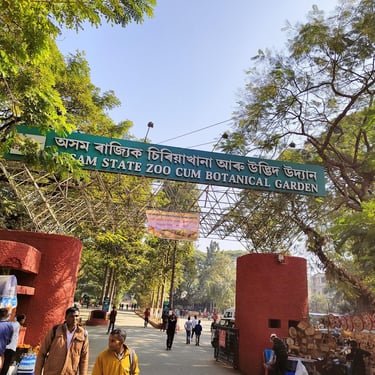
Assam State Zoo cum Botanical Garden
Distance from Hotel Prince B - 4.7 KM
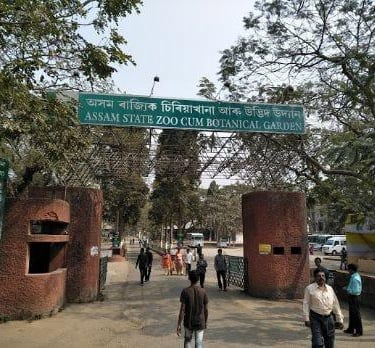
The Assam State Zoo cum Botanical Garden (often called Guwahati Zoo) is a major zoological park and botanical garden located on Zoo Road inside the Hengrabari Reserved Forest in Guwahati, Assam, India. It is the largest zoo in Northeast India and a key urban green space combining wildlife conservation with landscaped gardens and natural forest.
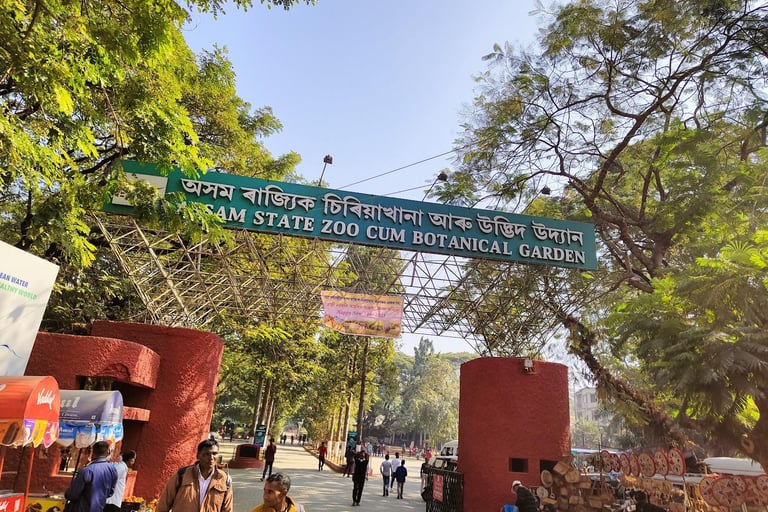
Key facts
Location: Zoo Road, Japorigog, Guwahati, Assam, India
Opened: 1 August 1958 (origin as a zoo dates to 1957)
Area: ~175 hectares / 432 acres, within Hengrabari Reserved Forest
Animals & birds: 1,100+ individuals from 100+ species
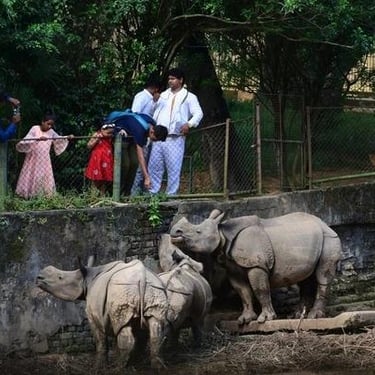
Notable exhibits: Indian one-horned rhinoceros, tiger, clouded leopard, hoolock gibbon, golden langur
History and development
The zoo’s origins go back to a small animal display organized during the 64th session of the Indian National Congress in Guwahati in 1957. After the event, the animals were moved to Japorigog in the Hengrabari Reserve Forest, where Assam State Zoo was formally established and opened to the public in 1958.
A dedicated zoo forest division was created in 1959, and in 1982 a botanical garden was added, giving it its present combined identity. In 2002, an additional 45 hectares of reserved forest were incorporated, expanding the zoo–garden complex to about 175 hectares and strengthening its role as a conservation-focused urban forest park.
Location, layout, and environment
The complex lies in the heart of Guwahati within the gently undulating Hengrabari hillocks (about 60–200 meters above sea level). Around 110 hectares remain natural forest, complemented by landscaped gardens, large animal enclosures, lakes, and walking paths. This blend of semi-wild forest and designed spaces creates a more naturalistic environment than many conventional city zoos.
The botanical garden section covers roughly 82 hectares of the total area and contains a variety of ornamental, endemic, and economically important plant species, making the site both a wildlife attraction and a living plant collection.
Animals, plants, and conservation role
Assam State Zoo cum Botanical Garden houses notable native fauna, including the one-horned Indian rhinoceros, Asian elephant, Bengal tiger, clouded leopard, hoolock gibbon, golden langur, Himalayan black bear, and various species of deer, primates, reptiles, and birds. Over time the focus shifted from exotic imports to indigenous species and ex-situ conservation, with captive-breeding programs for select threatened animals.
The botanical garden portion supports conservation and education around regional flora, while the broader complex functions as a biodiversity refuge inside a fast-growing city. Recent reports highlight efforts like temperature-control systems, misting arrangements, and modified diets to protect animals from extreme heat, reflecting an increasing emphasis on animal welfare and climate resilience.
Visiting experience
The zoo is among the most visited attractions in Guwahati, drawing several hundred thousand visitors annually. Walking trails run through forested sections and around enclosures, with signboards, a small ecological museum, and family-friendly amenities. Typical visits last 2–4 hours and combine viewing wildlife with enjoying shaded green areas, lakes, and the botanical garden’s plant collections.
Contact :
Reach us anytime for bookings or inquiries
Phone : +919876608800 , +919872208800
EMAIL: hotelprinceb@gmail.com
© 2026. All rights reserved.
ADDRESS:
HOTEL PRINCE B
Dr. B.Baruah Road, Opposite Nehru Stadium,
Ulubari, Guwahati-781007
Assam - India